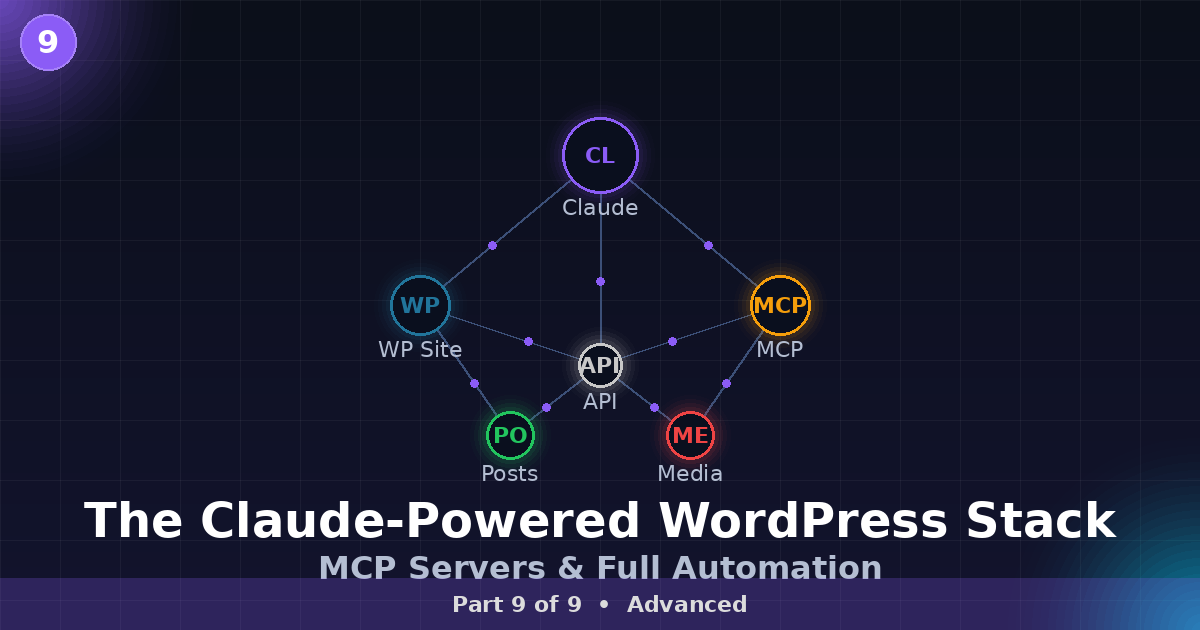
Everything covered so far in this series has used a simple pattern: you talk to Claude, Claude calls the REST API, your site updates. That pattern is powerful. But there is a layer above it — one where Claude has a persistent, structured connection to your WordPress site and can act autonomously without you initiating every request. That layer is the Model Context Protocol.
What Is MCP?
The Model Context Protocol (MCP) is an open standard developed by Anthropic that lets AI models connect to external tools and data sources through a structured interface. Instead of Claude improvising API calls from your instructions, an MCP server exposes a defined set of “tools” — functions Claude can call directly. A WordPress MCP server might expose tools like create_post, list_drafts, upload_media, and get_analytics.
The Difference It Makes
With a REST API integration, Claude needs to know the WordPress API structure and construct calls correctly each time. With an MCP server, the tools are described to Claude in a standardised way, which means more reliable execution, better error handling, and the ability to chain complex multi-step workflows — like “draft three posts on these topics, generate featured images for each, schedule them for the next three Mondays, and email me a summary” — as a single instruction.
Where the Ecosystem Is Heading
WordPress MCP servers are an active area of development in the open-source community. Plugins that expose MCP endpoints are beginning to appear, and the combination of Claude Desktop with a local MCP server running alongside WordPress is already used by early adopters for fully autonomous content pipelines. Claude monitors an RSS feed, identifies trending topics in your niche, drafts a response post, schedules it, and notifies you — all without a prompt from you.
You started this series by generating an application password. You are finishing it at the frontier of AI-powered publishing. The tools are here. The only remaining step is deciding how far you want to take it.
Vastaa